

This publication is the playground that gives me the freedom to organize my research and exercise my creativity.
If you enjoy electrifying essays—philosophy and fiction exploring the vital aspects of modernity—please consider becoming a paid subscriber. It costs less than a cocktail in town, and it helps more than you think.
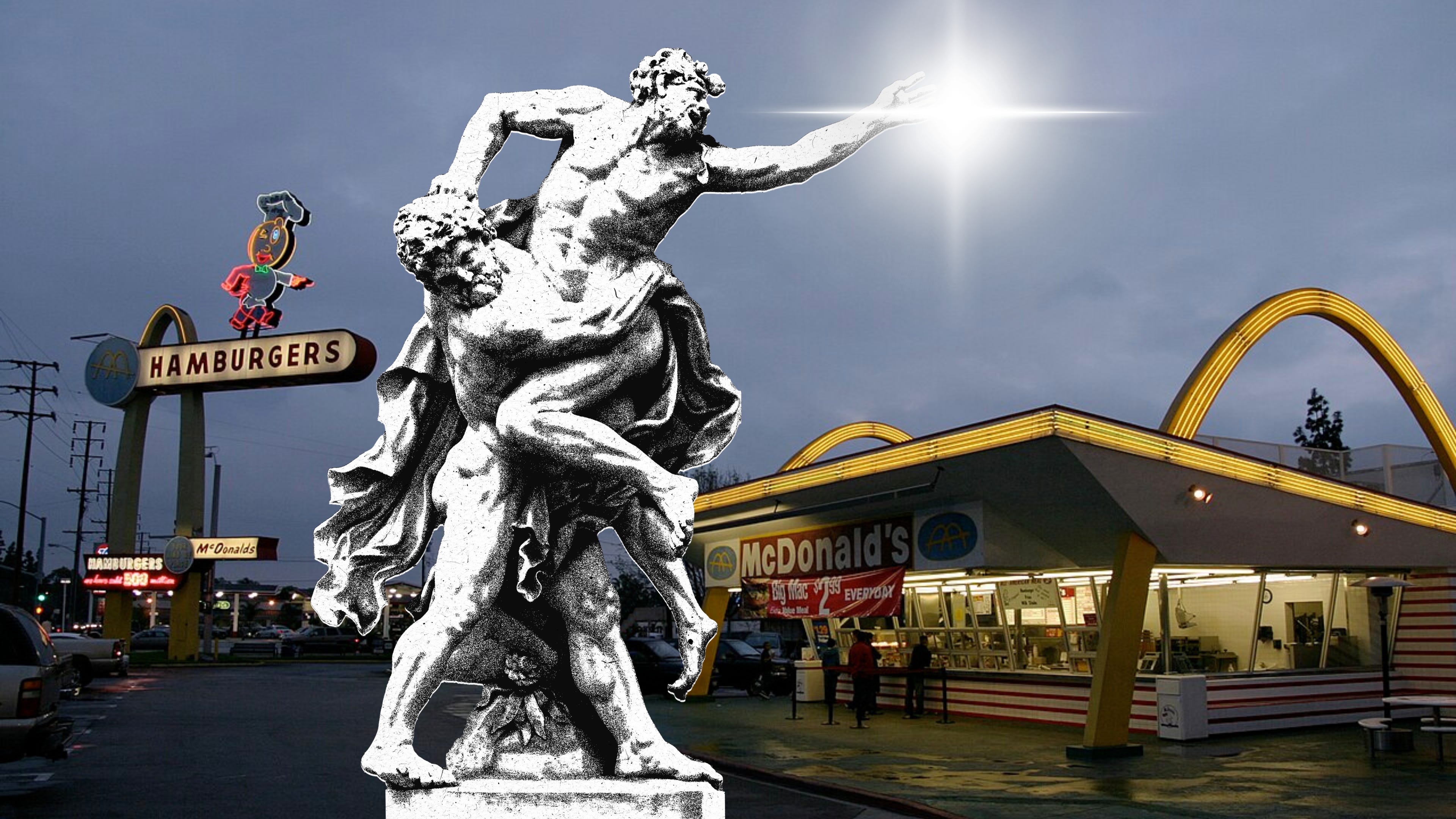
LET’S ALL TAKE a moment to pray to some of our evangelical atheists,1 such as Richard Dawkins,2 Steven Pinker,3 or Yuval Harari.4 In the name of Science, Technology, and Holy AI, we’re now enlightened enough to realize we’re nothing but a meaningless agglomeration of atoms, drifting through a vast cosmos governed by blind laws and chance. How can we make sense of the insatiable enthusiasm of our species over the past tens of thousands of years? Is it simply motion without aims, unfolding through time without any divine mission? What’s the ruin of our ambitions, breakthroughs, blunders, and tragedies? Why do we dare to dream? Why do we seek meaning? Why do we write poetry? Why do we paint? Why do we sing? Why do we dance? To produce dopamine? Why do we love? To produce oxytocin? Why do we enjoy the sea and the mountains and the forests so much?5 This nihilistic metaphysics produced inside the confined spaces of offices and laboratories wouldn’t qualify as embarrassing and disastrous at the same time if it weren’t trying to monopolize truth and embellish reason with an almighty aura.6
Don’t ever forget that the world is sacred and myth-woven. Science and technology help us understand great things but, from a cosmic perspective, we know very little. Stare at wildflowers and bees and butterflies. Cherish clear rivers and saints and painted churches. Reject dogma. Find shrines and pilgrim routes and folk music. Pray beneath the moon. Sit in the grass and stay in the rain. Be reasonable but not too rational.7 Life is deeply electric, add meaning to the ordinary, being a little bit mystical doesn’t hurt.
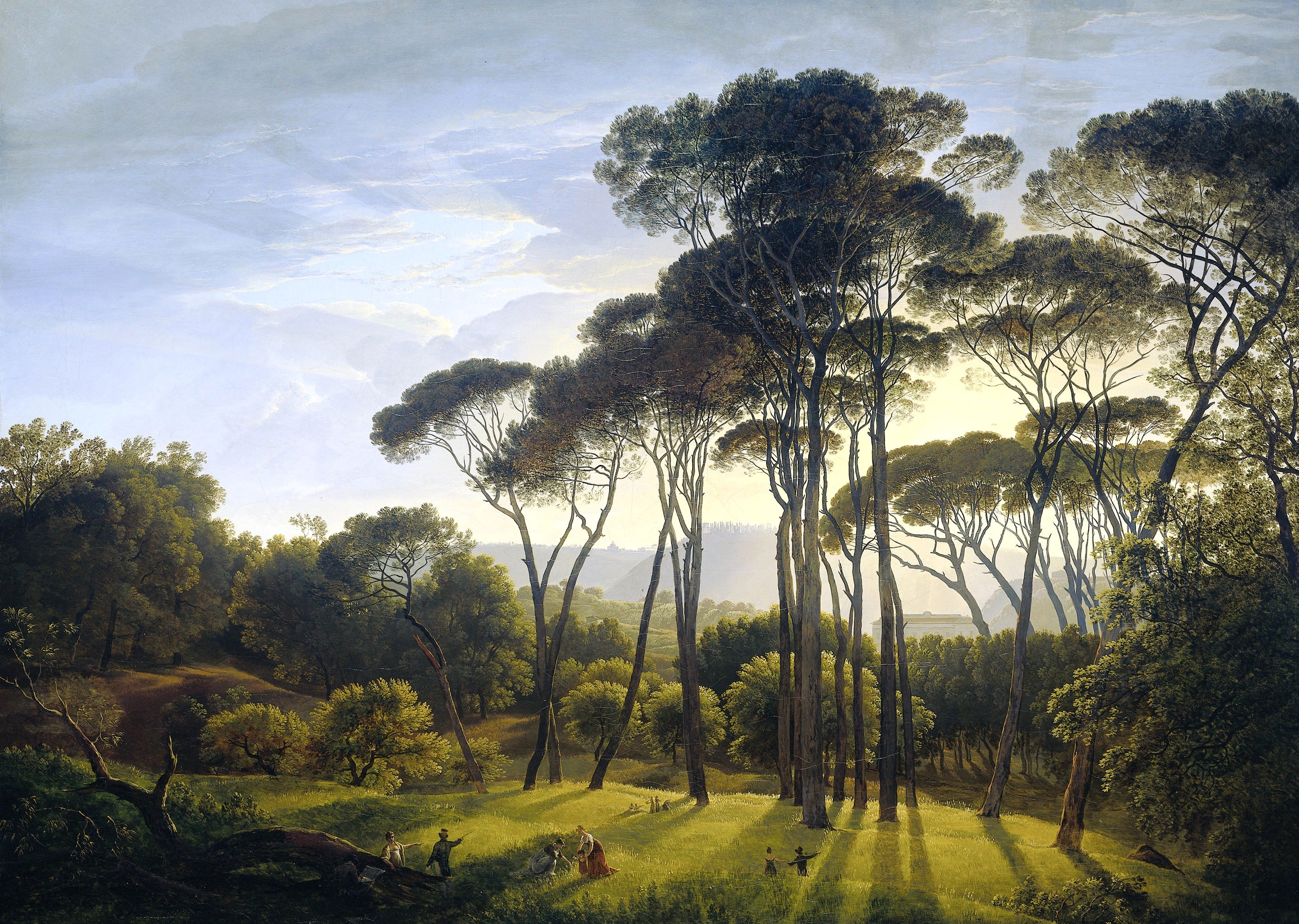
In Unweaving the Rainbow, Dawkins responds to John Keats’s frustration as to how Newton had “destroyed the rainbow” by explaining it through the prism and physics. Dawkins argues that to explain something does not mean to destroy its beauty. The explanation reveals a deeper beauty. If you know that starlight can be analyzed spectrally and that spectral lines tell you what chemical elements exist in a star, the sky thus becomes more interesting than it was before.
Dawkins terribly misses the point though: this is not an explanation. This is merely something new we learn about starlight and it doesn’t cancel the sacred, it doesn’t cancel mythology, it doesn’t cancel the religious phenomenon. It’s a lovely and extraordinary discovery—but certainly not an explanation. You may learn how a rainbow works scientifically and yet accept there’s something about the experience of seeing a rainbow that can’t be captured by the scientific explanation.
“Do you believe that the sciences would have arisen and flourished if wizards, alchemists, witches, and astrologers had not preceded them?!” Nietzsche insists. “They created the thirst and hunger and taste for hidden and forbidden powers.”
You (must) love the music we, lucky bastards, inherited from the likes of Mozart, Schubert, Debussy, Vivaldi, or Enescu. Science can explain frequencies, harmonics, the vibration of air, and even brain activity when we hear music. But who on earth has the audacity to claim that a symphony by Mozart or Enescu is nothing more but vibrations in the air? Does this qualify as an explanation? Does it satisfy you by any means? Dawkins seemingly tries to construct the innocent argument that science can be poetic. He doesn’t stop here though. This isn’t his true ambition. His ambition is to convince his audience that science can produce wonder through its explanations and non-scientific forms of wonder are inferior or intellectually suspect. I’m aware Dawkins doesn’t believe science provides absolute explanations; but he does believe the scientific approach to be the primary or only veritable path to understanding the world around us. Other sources, such as religion, mythology, or folklore, are to be dismissed and even laughed at.
“Atheists are just modern versions of religious fundamentalists: both take religion too literally.” Nassim Taleb
How to Enter Euphoria
In the movie The Yellow Tie,8 there’s an entertaining scene where the famous Romanian conductor Sergiu Celibidache has a casual chat over lunch with some business executives coming from Japan. They want to talk Celibidache into signing an agreement which would finally lead to his music being recorded, packaged, making it scalable, and distributed worldwide for profit—the demand is high. He could become rich in the process and leave behind a massive financial aid for his offspring. A no-brainer for almost any musician.
Celibidache firmly rejects the offer because of “the impossibility to reduce (his) music to simply two dimensions.”
One of the executives tries to double down on his offer:
“But our technology will soon be able to produce a perfect replica of the live experience of your mu-”
“No, it won’t,” Celibidache interrupts him while his anger is building up. “Your technology only takes us further and further away from the live sound and the live audience listening to the sound in a concert hall.”
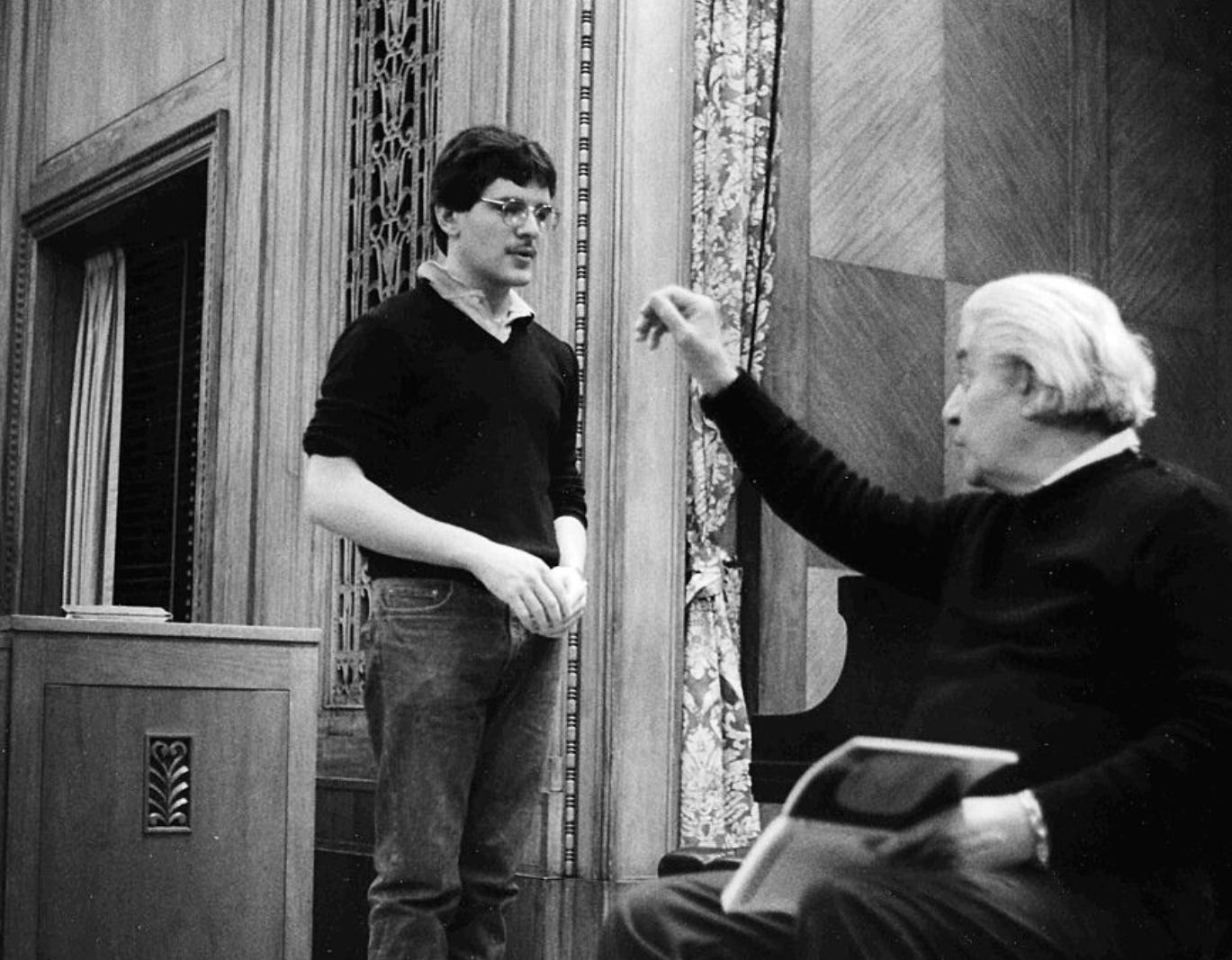
Recordings, especially of classical music but not only,9 can’t capture texture, tension, depth, or lyricism. It’s not sublime. Because it’s not live and it’s not played in exactly the context and the dynamics it was designed for. All the richness is gone.
During an interview, Celibidache was asked: “But what will remain of your music after you’re dead?”
“Nothing,” he replied.
The interviewer asked why.
His answer still stays with me whenever I contemplate my new endeavors...
“Because of the nature of the project which I’m pursuing. Why would you want to get fixated on what impressed you at some point in the past instead of preserving inside the depths of your soul the ability to get impressed and the elements necessary to enter euphoria in the present moment?”
One factory defect almost all humans share is that we constantly postpone the zest and will to go all in on the present moment. Without the present, we can’t access the sacred. Modernity distracts us from living in the sparkling present and traps us in an overhyped past.
The Unrecognizable Sacred
ATHEISTS LOVE to challenge the existence of God. Belief in God is widely rejected as a sign of emotional and intellectual immaturity. If they can rhetorically “cancel” this belief, they won the battle. God doesn’t exist. The most boring and unscientific way to think about a religion is to consider whether or not it’s “true” from an epistemic point of view. Looking at, say, Adam and Eve through this lens—“did it happen or not; do we have proof or evidence?”—is not a sign of intellectual, let alone spiritual, velocity. Firstly, before religion is a matter of abstract belief, it’s (both historically and existentially) a matter of practice: rituals, ceremonies, rites, traditions, communal life, symbols, sacred spaces. Belief is embedded within a way of life. Secondly, “belief” points us toward something richer than merely assenting to a proposition. The Latin credere means “to believe,” but also “to trust,” “to rely upon,”—so belief in its original form is not the passive claim that something is true; believing in something means allowing it to shape your life.
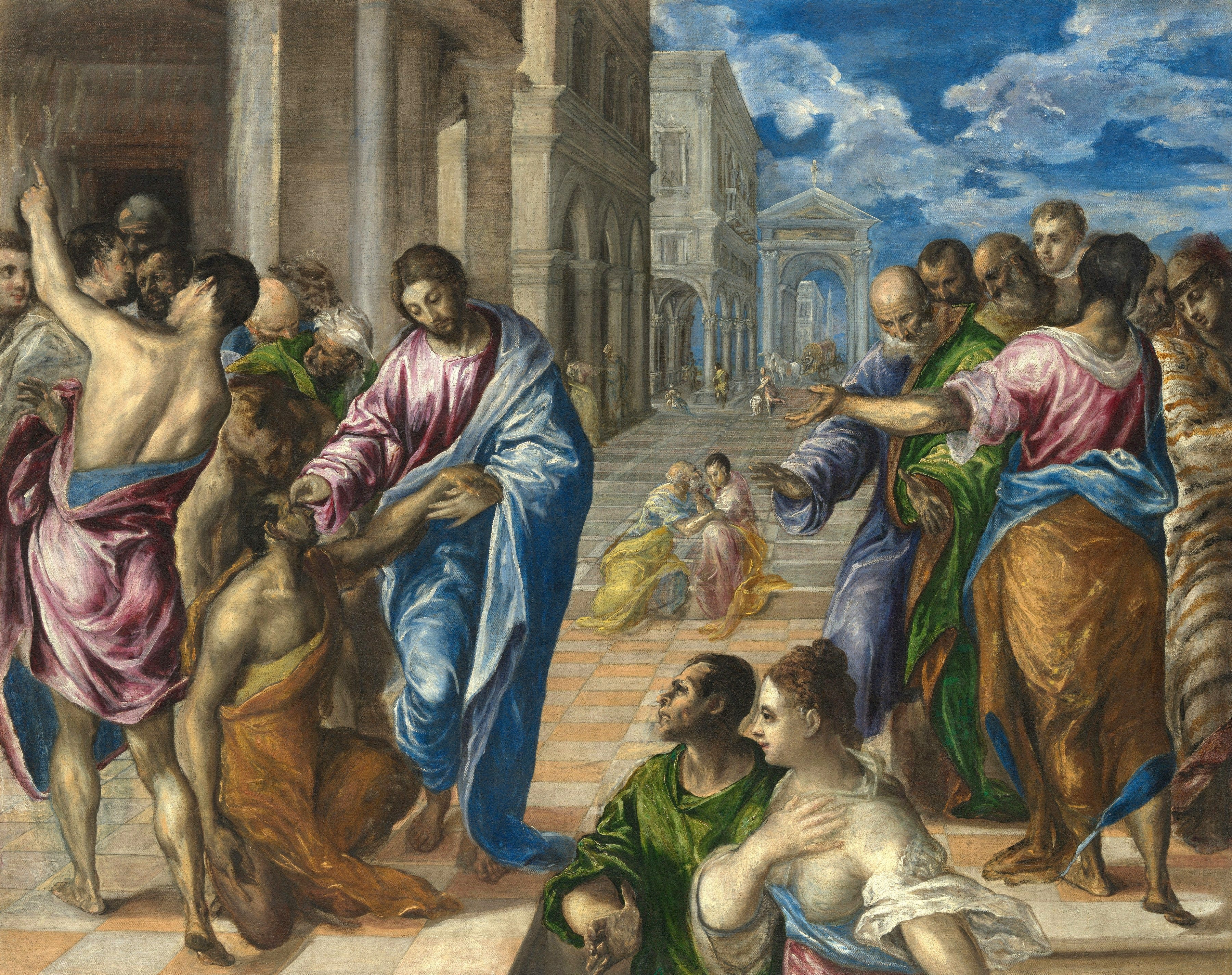
But here’s where the tension truly starts building up. Mircea Eliade—the most prominent scholar of the history of religion, and perhaps the first major scholar to study religion as a subject in its own right, rather than merely from a psychological or social perspective—joins the party:
Irreligious people still behave religiously, even though they aren’t aware of the fact. The experience of the ancient religious sentiment is by no means alien to the consciousness of modern humans. Some believe they have freed themselves from the sentiment. This sentiment is an illusion. The irreligious have “emptied themselves” only of the content of religion, but have inadvertently retained the form of religion in their thought and behavior. The atheist, whether he likes it or not, descends from homo religiosus... His formation begins with the situations assumed by his ancestors. The modern man who feels or claims that he is irreligious still retains a very large stock of camouflaged myths and degenerated rituals […] What we see today is that man considers himself to have nothing sacred, no God, no religion—but still his life has a meaning, because without it he could not live; he would be in chaos. Purely rational people are never found in real life. The majority of men without religion still hold to pseudo-religions.
The irreligious can’t escape the sacred. They’re also looking for it, even though based on different intensities and often even without knowing. They can’t eradicate their spiritual configuration. Humans are homo religiosus—this is not an evolutionary argument. We have likely expressed our religiosity from the beginnings of—not civilizations but—existence, when we actualized our humanity. At Shanidar Cave in Iraq, archaeologists found several Neanderthal remains that appear to have been ritualistically buried around 60,000–75,000 years ago. It can’t be a cultural argument; it’s not thanks to civilization X or Y or Z that we’re religious. Things we now see as ordinary practices, such as dance, painting, music, and agriculture, used to have a sacred dimension. They were not mere activities but originally connected to the sacred. “The sacred is an element in the structure of the consciousness, not a stage in the history of the consciousness,” Eliade writes. He elaborates:
I don’t understand what the so-called irreligious man wants to tell me when he declares: “I don’t believe in God.” For example, I don’t think that Jean-Paul Sartre gives all of himself in his philosophy, because I know that Sartre dreams and likes music and goes to the theater. And in the theater he gets into a temporal dimension in which he no longer lives his moment historique. There he lives in quite another dimension. I can’t cut this complete man off and believe someone immediately when he consciously says that he isn’t religious. I think that, unconsciously, this man still behaves as the homo religiosus; he still has some source of value and meaning, some images are nourished by his unconscious, by the imaginary universe of the poems he reads, of the plays he sees. I can’t limit his universe to the purely rationalistic universe which he pretends to inhabit.
Consider how you feel when you read a great book. Dance with someone you love. We live in another dimension when we listen to Bach. Another experience of time is given in drama. We also dream. Spending two hours watching TV is not equal to spending two hours at a play.10 Imagine how you feel when you enter a monastery compared to how you feel when you enter a shopping mall.11 The revelation of a rich and meaningful world is intimately linked to the discovery of the sacred. The distinction between a meaningful and meaningless world is an extension of the war between the sacred and the profane.
The Disenchantment of the World
WE’RE PERHAPS facing one of the most difficult spiritual crises in history. We’re religious, whether we like it or not, and yet we have desacralized our world. Some like to refer to this process as the disenchantment of the world, a process whereby human existence was gradually stripped of its spiritual, symbolic and magical dimensions.
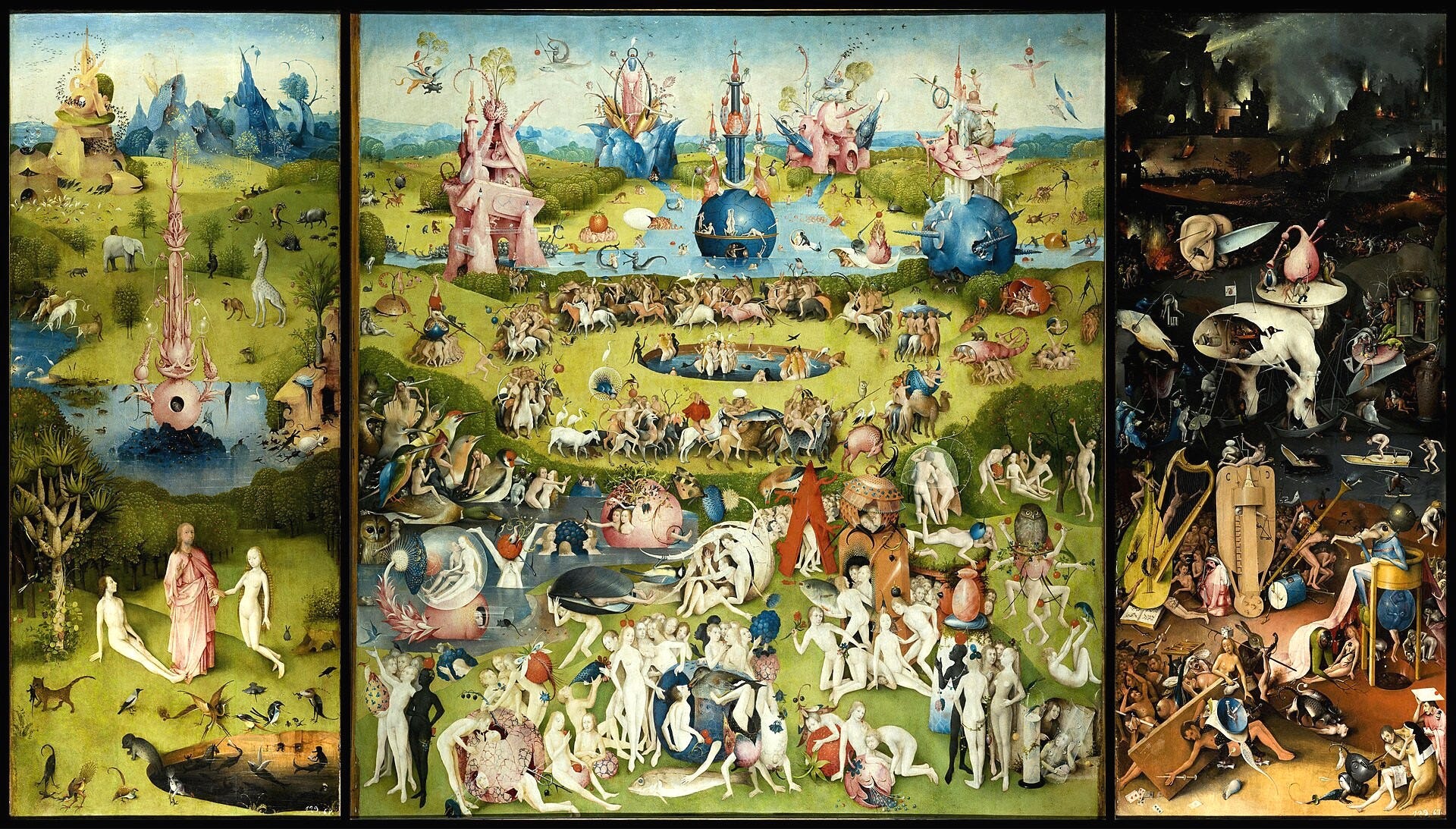
What blew my mind about Eliade’s thesis was the way he put into perspective Christianity’s role in this transformation. When Christianity came to Europe, it changed the way nature was perceived, altering its aura. Nature was no longer understood as sacred in quite the same way it had been within earlier Indo-European traditions. A tree or stone wasn’t necessarily a sacred object. Nature became creation: something made by God and therefore radically distinct from God. The same transformation applied to the cosmos itself: the planets and stars increasingly became things that could be studied.
This slow desacralization of nature paved the way for the scientific movement and ultimately the disenchantment of our world. Once the natural world was stripped of some of its sacred character, it became possible to examine it and treat it as a commodity. Modernity thus fails to protect the environment because it considers nature valuable only insofar as it serves humanity rather than deeming it divine. Nature could be studied, categorized, measured, and ultimately subjected to scientific or technological exploitation.
Now, it would be a reckless intellectual leap to say that Christianity desacralized nature or that Christians regard nature as spiritually meaningless. It’s more likely that what happened was a paradoxical transformation. Christianity abolished the way nature was perceived in archaic traditions in order to radically change the form of the sacred. Yet its goal was to preserve a sacred understanding of the cosmos—over the long term, the project failed.
As already mentioned, the slow desacralization of nature contributed to the emergence of the Enlightenment and the scientific movement that followed—and, at some point, this culminated in the death of God in 1882, symbolically declared by Nietzsche, which meant that we had also succeeded in desacralizing virtually the entirety of human existence. We’re now in chaos. “Just as nature is the product of a progressive secularization of the cosmos as the work of God, profane man is the result of a desacralization of human existence,” Eliade writes. In Judeo-Christian terms, one may refer to this as the “second fall.”
“God is dead. God remains dead. And we have killed him.” Nietzsche (1882)
What Nietzsche meant by the death of God isn’t so much about atheism per se, but about the cultural and existential consequences of losing the shared metaphysical framework established by Christianity. Morality and meaning must now be reinvented and reimagined. Nietzsche also suggests that this creates the potential for greater danger on a collective level—he’s not wrong—but also presents an opportunity, as we are now the creators of our own destiny—we’ll see about that.
“Many of the crises of modern man have some sort of religious origin, quite simply because a [religious] crisis is above all the awareness of an absence of meaning.” Mircea Eliade
Let’s now explore some of the ways in which our religious crisis has manifested itself—and continues to manifest itself—in front of our eyes.
1. The Proliferation of Digital Worlds
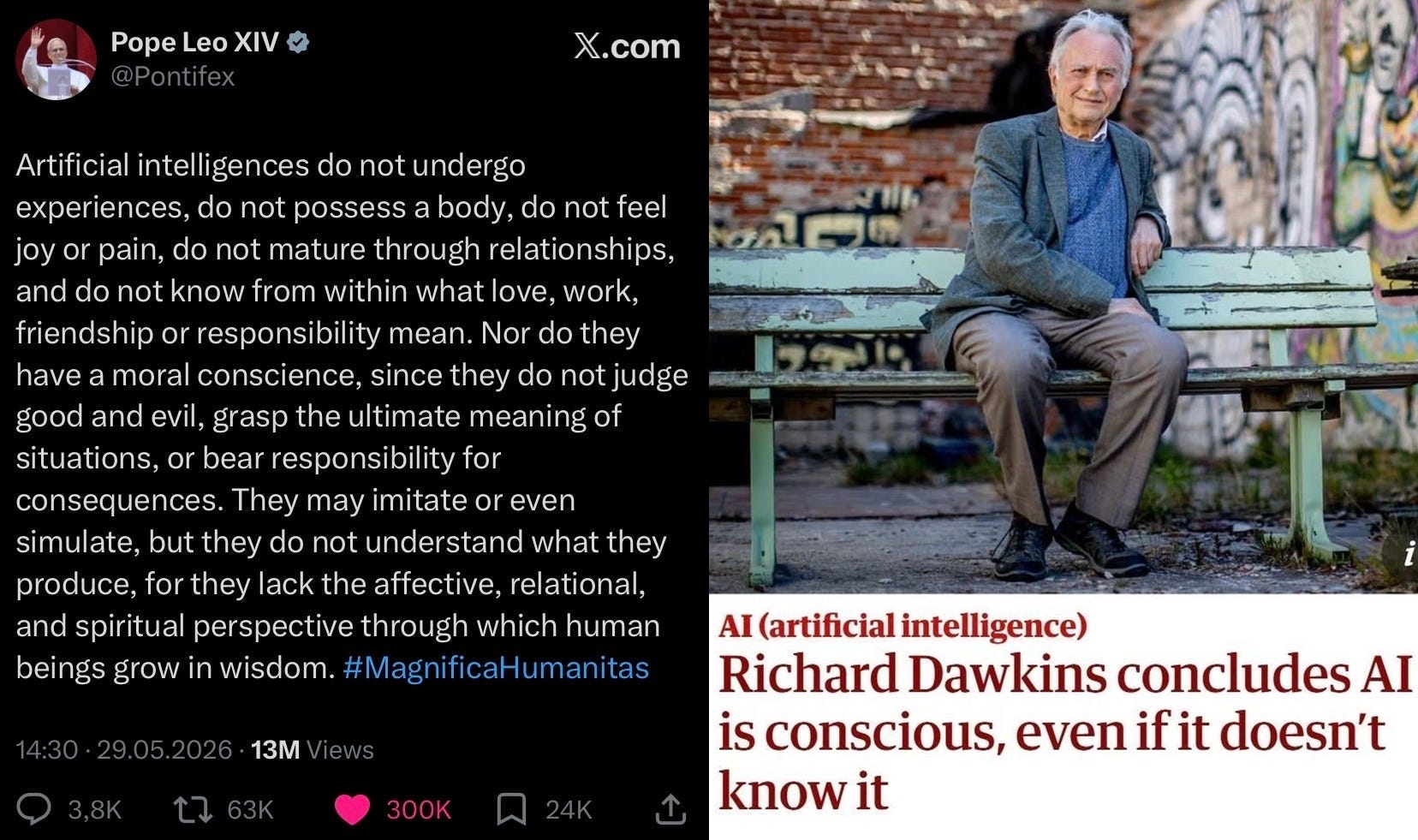
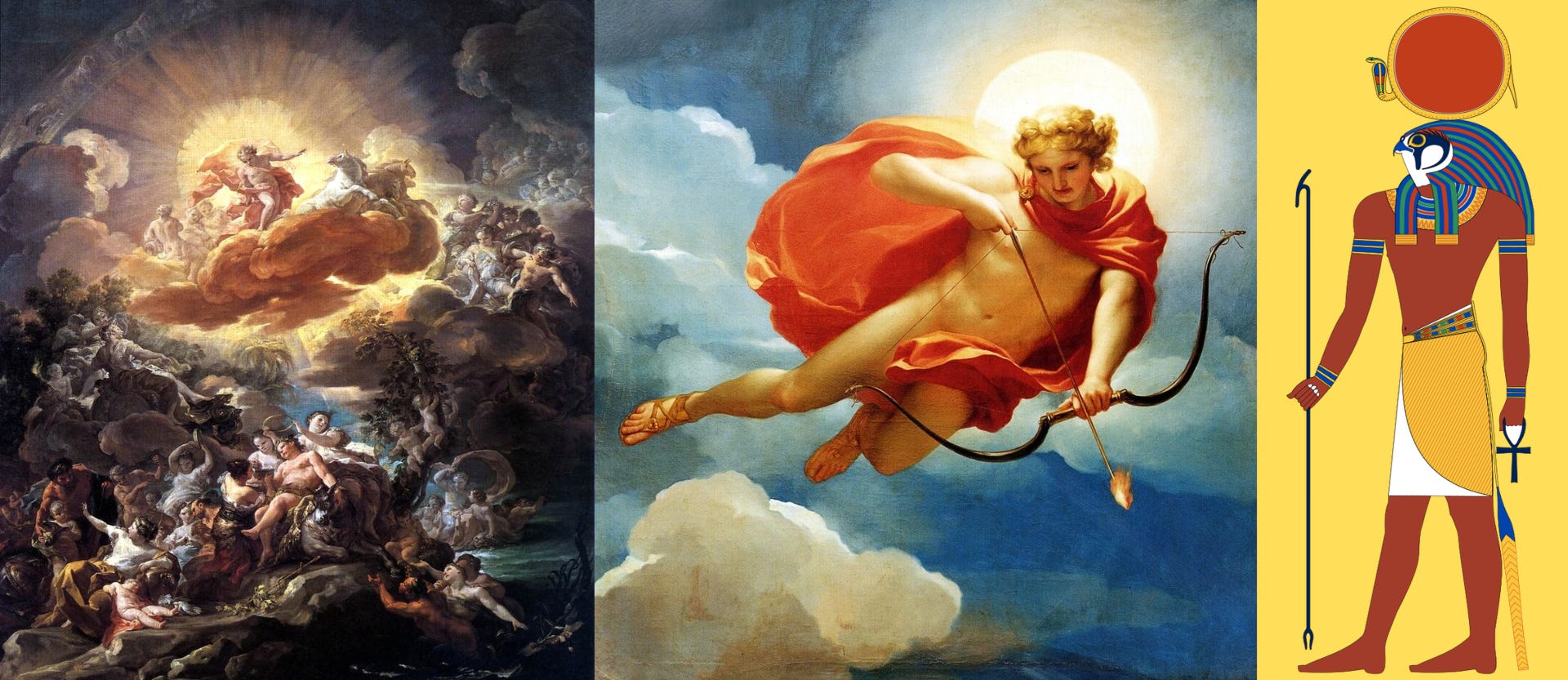
One of the most prominent defenders of atheism believes in AI ghosts and the Pope doesn’t. What a time to be alive! Now, please consider nerdy enthusiasts who get so excited to explain how we live in a “computer simulation”—remember when people used to spend all day outside and thought sun gods like Ra, Helios, or Surya were in charge? There’s truly nothing new under the sun. The simulation hypothesis is “an adaptation of belief fit for the internet age; it has its echoes in the Veil of Maya, and in the creationist myths,” Jacob Riley argues.
“The only difference between the irreligious and the religious is that the irreligious lack a viable means of truly actualizing their innate religiosity.” Mircea Eliade
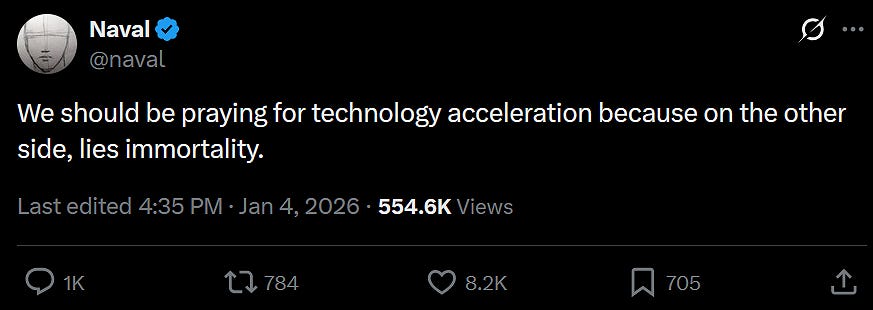
This pattern is not hard to spot. Look at how tech founders talk about AI: we need to “harness its power,” “unlock its potential,” “unleash its greatness,” and “put it to work for humanity.” The language is remarkably close to the way humans have always spoken about forces greater than themselves. They don’t build “tools”—don’t be gullible. This is a lie. They invoke new gods and dream of spiritual ecstasy.
Going back to Jacob Riley, he wrote a fascinating essay for Chisel, one of the best I’ve read on this app, called Space and the Screen in which he explores how modernity is struggling to create a new mythology. A few witty remarks:
1/ Setting foot on the moon is one of the two definitive moments of the 20th century, the other being the dropping of the nuclear bomb. What could be more significant, more worthy of mythology, more inaugural of a new epoch than these 2 things—the placing of the earth’s destruction in our hands, and the first footfall on another celestial body?
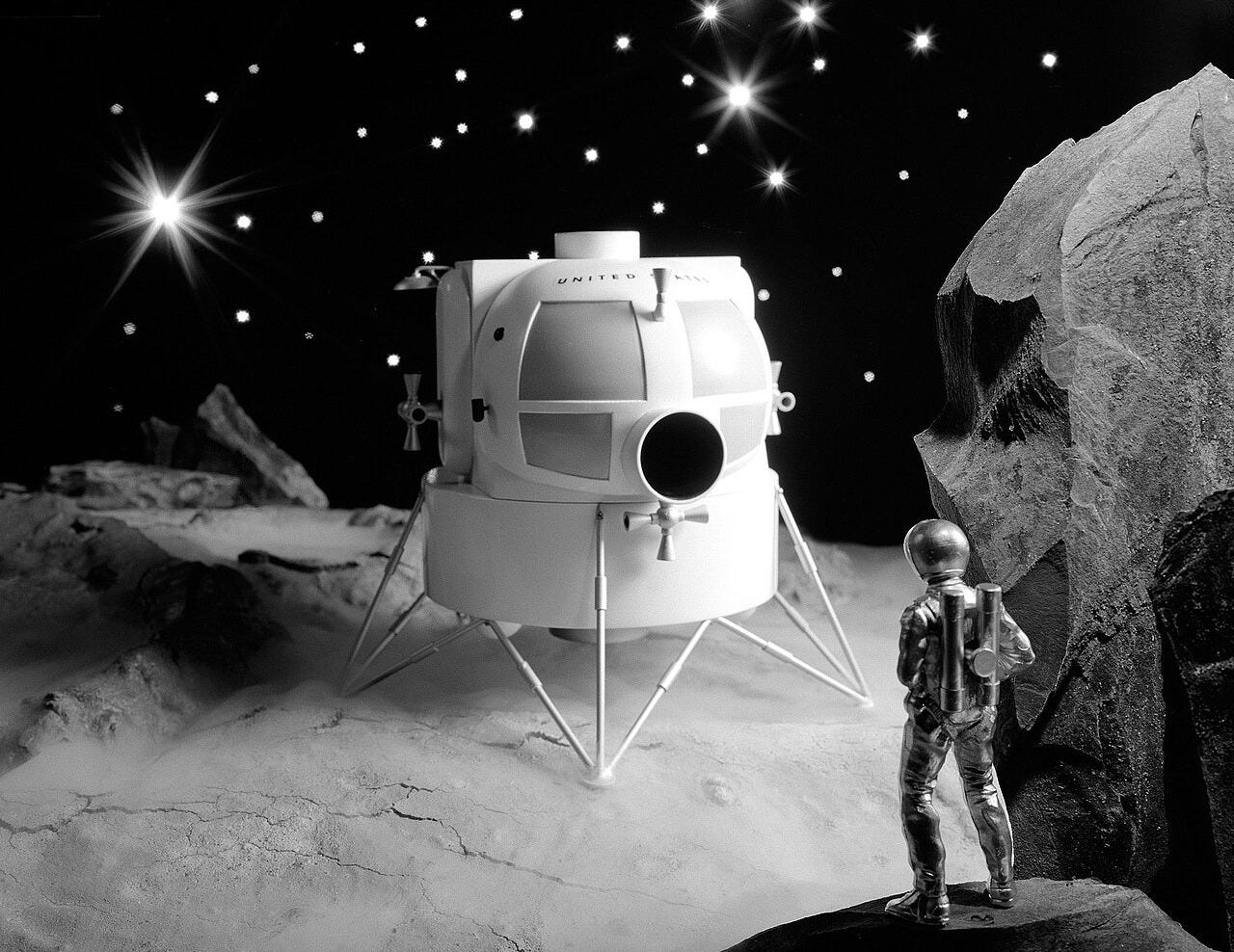
2/ Perhaps it’s written into the nature of a materialist age of empire that a time comes when there are no more worlds to conquer, or the conquest is brought to an end, and what has been acquired must be considered—the shift into contemplation—before it slips away. The possibilities of space seemed endless to the dreamers of the mid-20th century, but they were founded on fantasies, hypotheses, and images seen through telescopes or TV screens. The cold reality of the moon landing revealed what we had always known: that space is inhospitable to human beings without the kind of extreme adaptation that would push us beyond humanity as we had known it. The astronauts came back singing the praises of the earth.
I don’t want to give more spoilers—I hope this will be your next read on this app.


For thousands of years we looked up the sky wondering what’s there. Then we discovered a few things. How often do people talk about space? Once a week? Once a month? Once a year? The truth is—humanity at large doesn’t care about space, at least not anymore. Maybe you care; but most people don’t. How often do people talk about AI? Clearly too often.
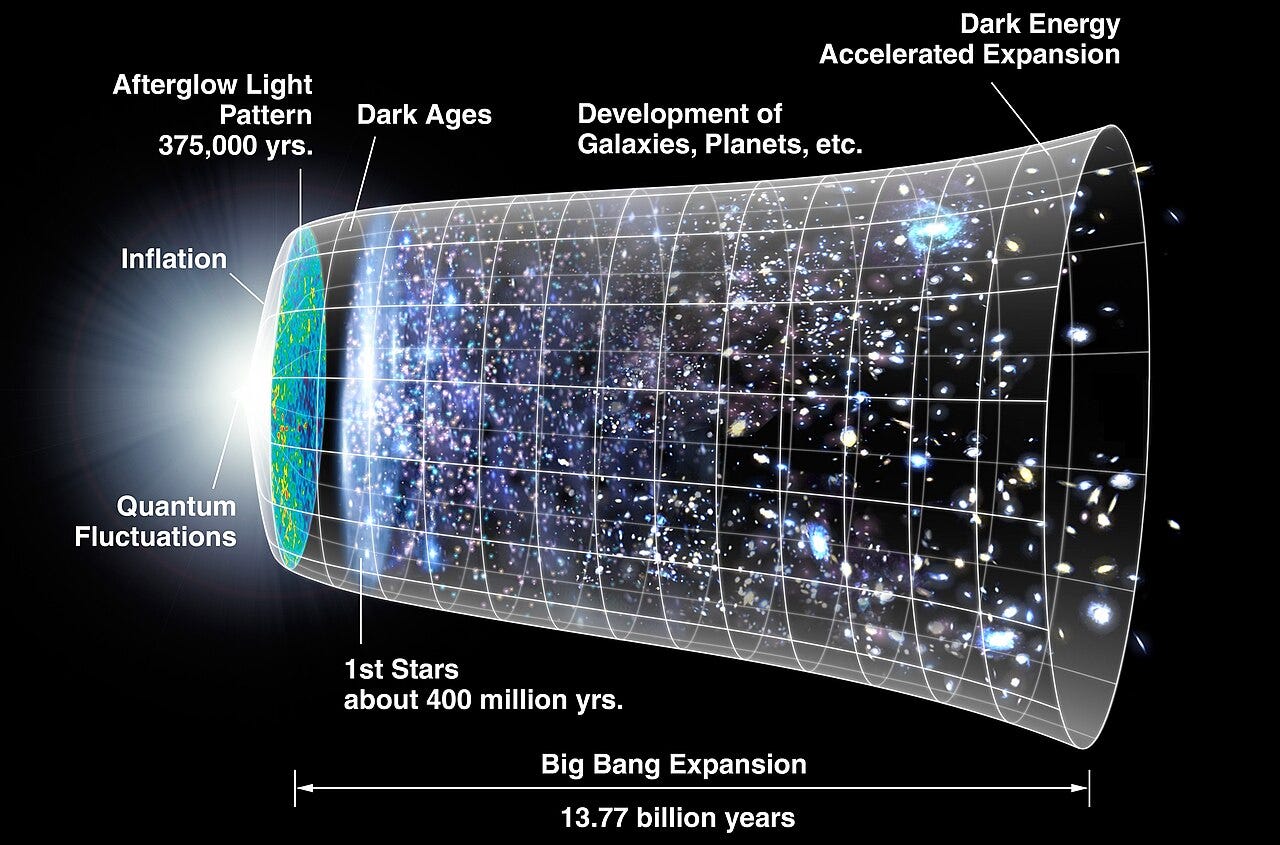
The computer simulation hypothesis has replaced the Big Bang hypothesis12 (yes, they’re not “theories”—sorry!) at least in terms of popularity. My bet is that this coincides with humanity’s loss of enthusiasm for space, as people have instead turned their attention toward the marvels of the internet and, now, AI. You might argue, “But AI is just a bubble.” It could very well be—but it doesn’t matter. What matters is that humanity is actively searching for a new religious conception, without necessarily being aware of it.
2. The Rise of “Isms”
We ironically call the Middle Ages the “Dark” Ages but the most morbid and inhumane crimes were committed during the Enlightenment or modern era. Think of concentration camps, genocides, eugenics, large-scale racism, or forms of totalitarianism such as communism (which is fundamentally atheistic), fascism, and nazism. Will Manidis isn’t wrong: “The failure of the Enlightenment project was believing that we could get the outputs of religious civilization without the inputs. [What we now learn is that] without a transcendent end, all secular ethics inherently will rot and fall away.”
“While the traditional man roots meaning in transcendence, the modern man perceives meaning in materialistic ways. He compensates for his lack of verticality by an excessive horizontality. Lacking quality, he searches for meaning in largely quantitative terms. What he lacks in wisdom, he makes up for in cleverness. What he lacks in wonder or reverence, he strives to express in idolatry. What he lacks in spirituality, he seeks in hallucinatory experiences. What he lacks in religion, he pursues in false utopias, progressivism, environmentalism, consumerism, scientism, corporatism, communism,13 and fascism.” After Ali Lakhani
BNG, the founder of Brain Bar, came up with a witty observation: “Both the conquest of nature and the rise of ‘-isms’ and ideologies began after the Middle Ages—and conspicuously coincided with the declining role of religion. A coincidence? Hardly.”14
3. Hippies & Kaly Yuga
“The syndrome of Kali Yuga is marked by the fact that it’s the only age in which property alone confers social rank; wealth becomes the only motive of virtues, passion and lust the only bonds between the married, falsehood and deception the first condition of success in life, sexuality the sole means of enjoyment, while external, merely ritualistic religion is confused with spirituality.” Mircea Eliade
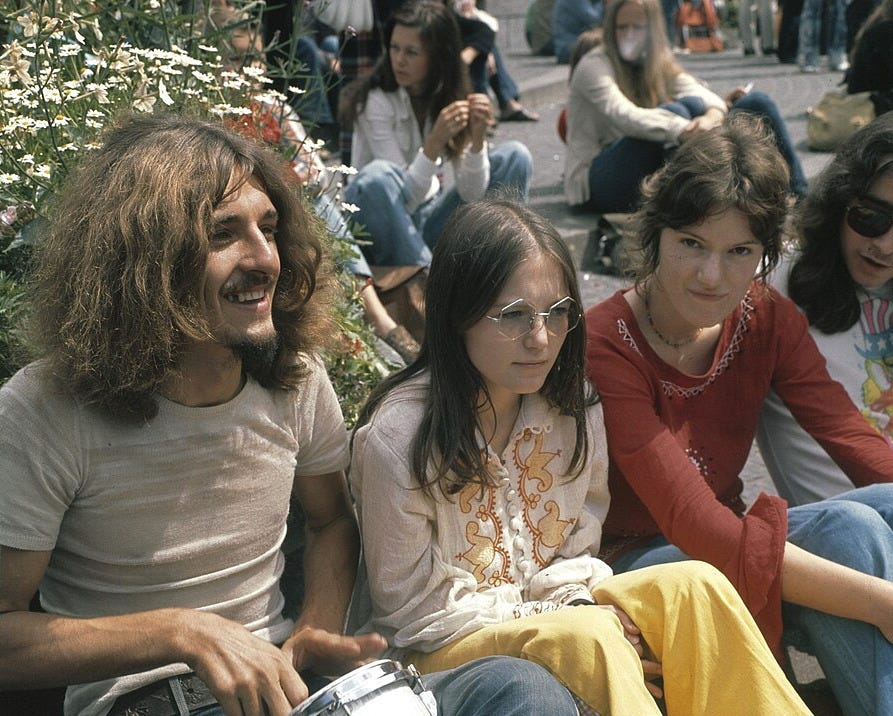
Do you remember the generation of hippies, who longed for a nostalgia for paradise? What could this be but another manifestation of our religious crisis, a search for the sacred, even if unsuccessful? “What else could their escape from society and institutions, their attempt to live in harmony with the pace of the cosmos, and their refusal to work for money mean?” Eliade wonders.
4. Reductionism in Modern Art & Architecture
From the Renaissance to abstract art, Western painting—with some exceptions—can be understood as a gradual reduction of the visible world to its most essential elements. Consider Renaissance art, then Impressionism, then Expressionism and Fauvism, and then Cubism. This progression is, in my view, not a nourishing search for essence, as some claim, but a gradual loss of the depth and texture that once made the world feel fully inhabited.
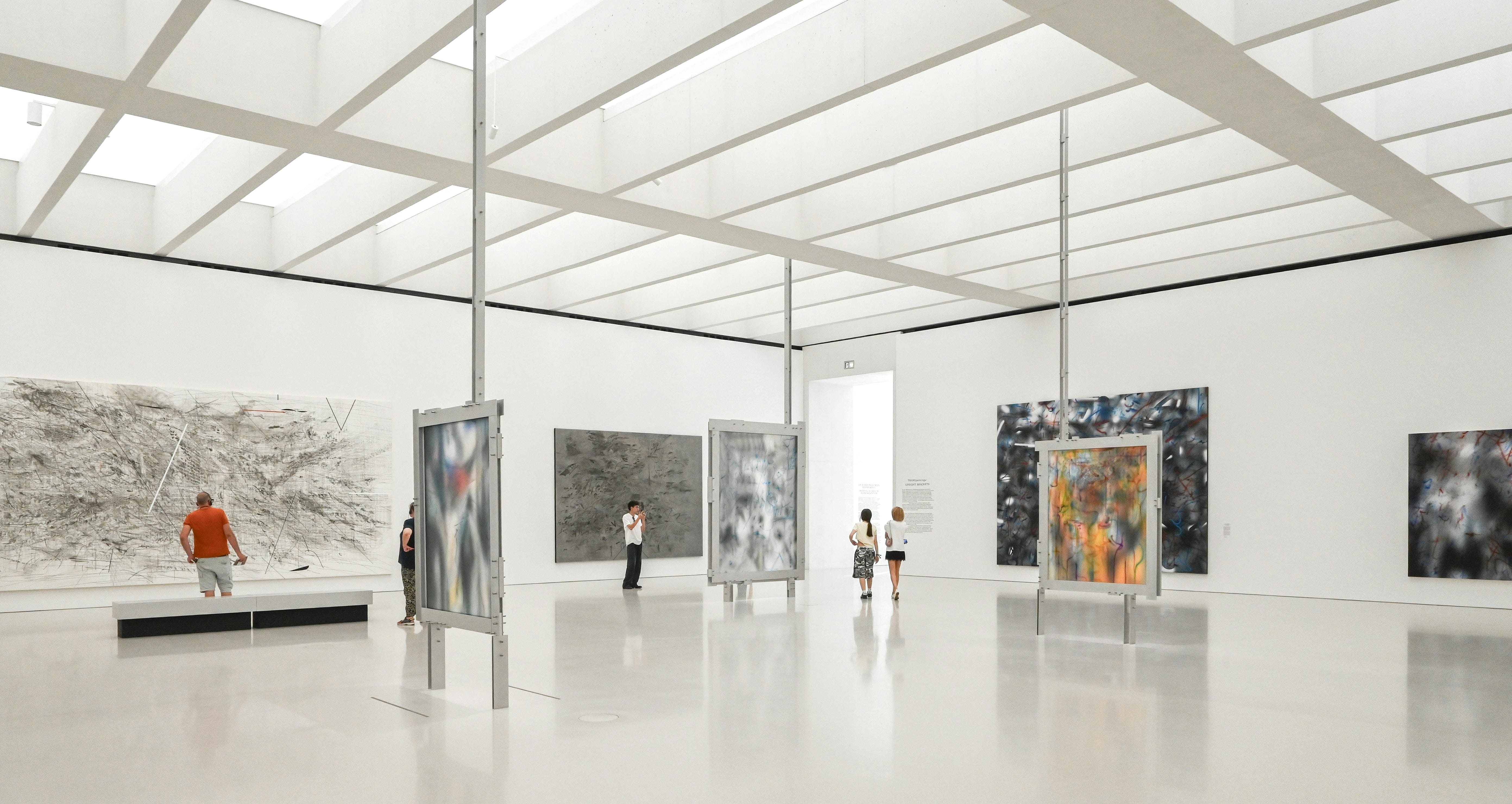
What could this final reduction be but a mirror, in the realm of art, of the growing scientific impulse to penetrate beneath appearances and reduce the visible world to its smallest material constituents—atoms, particles, forces? This also coincides with the worship of Euclidean geometry in architecture and urban planning, with Le Corbusier being the “illustrious” leader of this cult—giving rise to some of the worst projects the world has ever seen.15
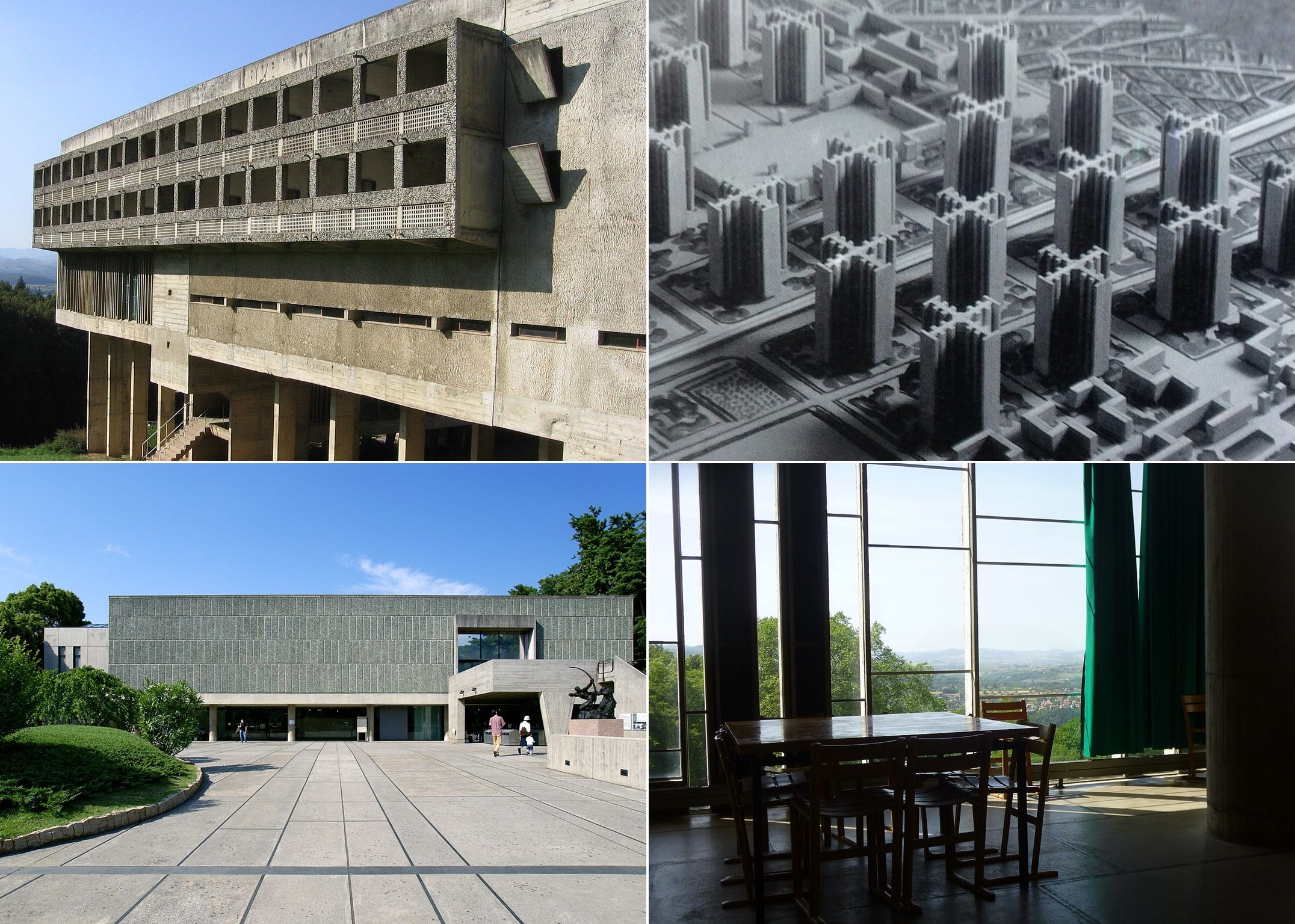
Just as Dawkins or Corbusier, many contemporary artists and art connoisseurs share the same remarkable fascination with the most basic elements, reducing the wealth of human experience to ever more abstract and impoverished forms—until almost nothing remains. I find myself utterly unimpressed and bored by it, although I can’t help but make a playful guess: this phenomenon has explosive religious consequences! Seemingly out of nowhere—this extreme reductionism is one of the final steps in destroying the “old world” so that modernity can build a world of its own from the top down.
“One of the characteristics of cosmic religion both among the primitives and among the people of the Ancient Near East is precisely this need for periodically annihilating the world in order to be able to recreate it. The annual reiteration of the cosmogony implies a provisory reactualization of chaos, a symbolic regression of the world to a state of virtuality. One can’t “repair” the world; one must annihilate it in order to recreate it […] To acquire a world of his own, modern man has desacralized the world in which his ancestors lived.” Mircea Eliade
Is a theology based on the “death of God” plausible? The death of God, since humanity can’t possibly be irreligious or fully rational, signals only the impossibility of expressing a religious experience in traditional religious language—in Christian language, for example. This is what I will explore in one of my next essays, which will be available only to paid subscribers.
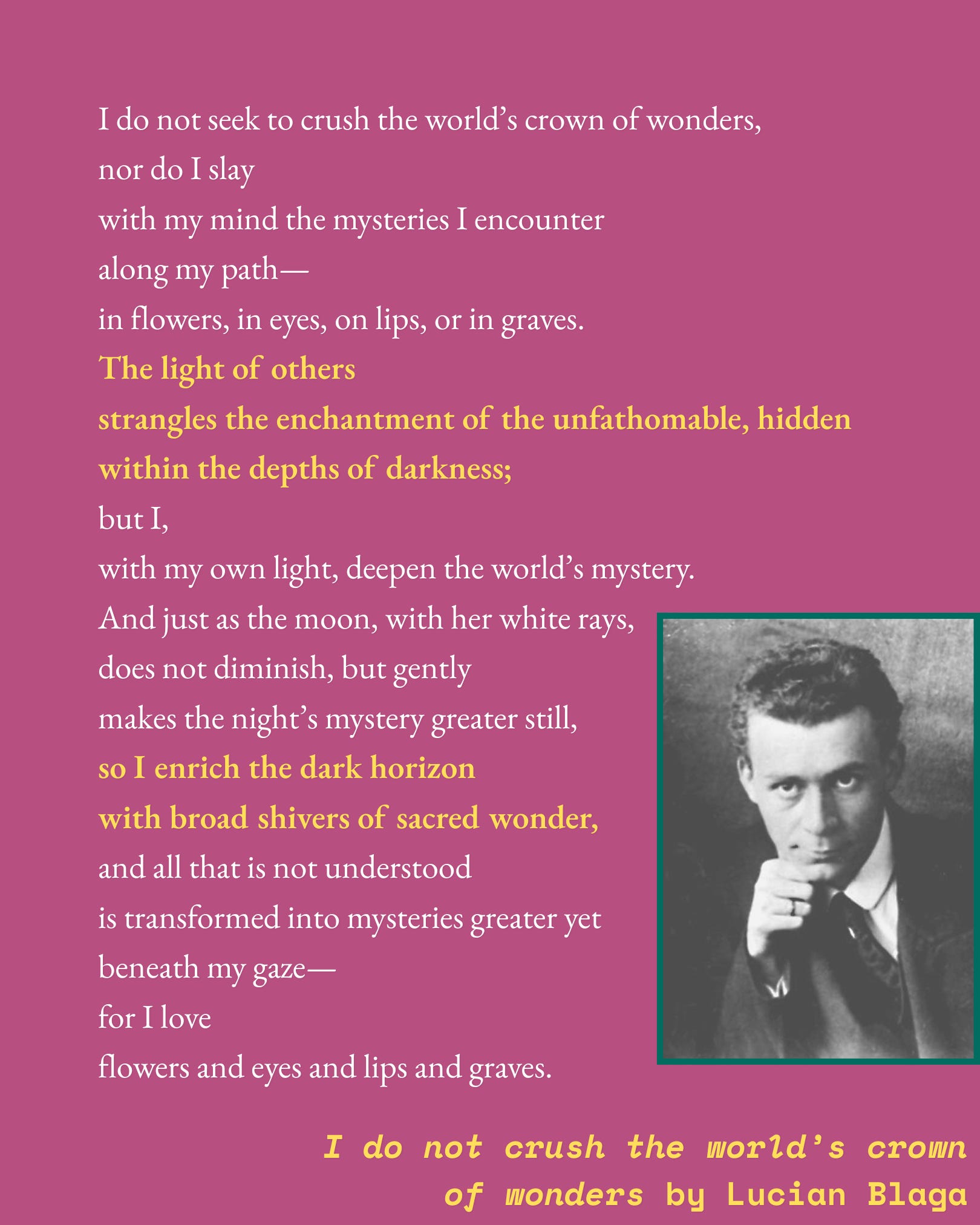
I will finish this essay with one of my favorite poems by Lucian Blaga, on the disenchantment of the world. Read it slowly. Enjoy!
This theme will be tackled during my next Art & Philosophy retreat in rural Transylvania, taking place in early October, most likely during the symposium, which can be properly described as a 5-hour contemporary intellectual (poetry & philosophy) soirée featuring wine, cheese, a gourmet dinner, and a campfire.
Art & Philosophy Retreat | Early October 2026 | Rural Transylvania
This year, I hosted the 4nd edition of “Sipping Wine in Transylvania” in July. The 5th edition takes place in early October—we return to the Saxon villages of Transylvania, with fortified churches and medieval architecture.
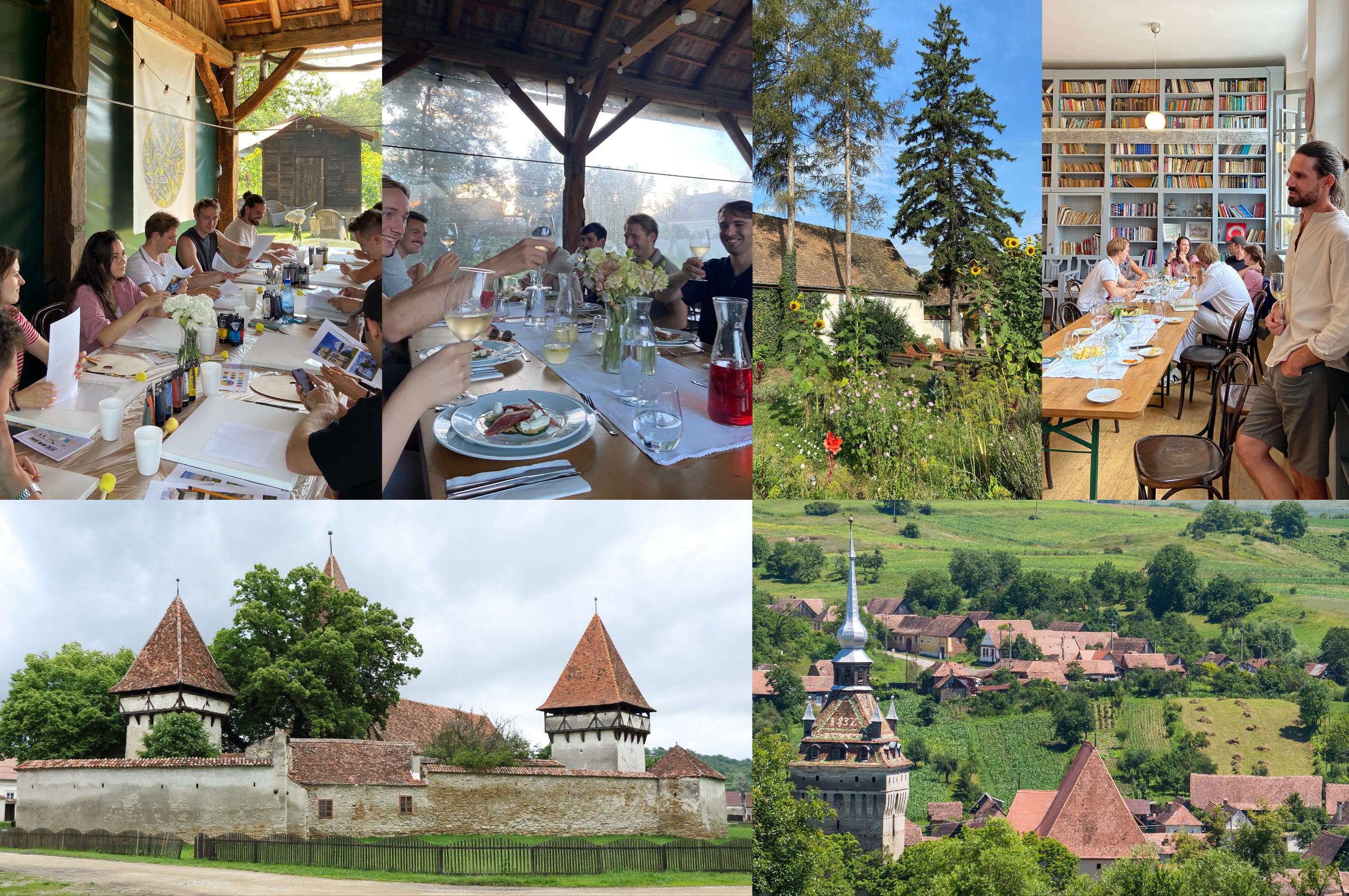
Why Transylvania?
“When I first visited the Saxon villages of Transylvania almost 15 years ago, I was deeply impressed by how these medieval settlements and the wild countryside which surrounds them had remained so well preserved for so many hundreds of years. Together, they formed an extraordinary landscape and harmonious farming system, uniquely rich in biodiversity, which was the only example of its sort left in Europe.” King Charles
If you’d like to receive more info about this, including reviews from former members, send an email to viziandrei@outlook.com. I only organize 2 retreats per year. Please include RETREAT in the subject line.

But don’t be too quick to think that this essay is me taking a stab at 3 fellows—famous ones, indeed. They’re not responsible for this movement. They didn’t engineer it. They’re merely the tip of the iceberg, the periphery of the movement; they’re, therefore, simply caricatures—the kitsch of the scientific and technological revolutions. They shouldn’t get flattered.
Dawkins in his book The Selfish Gene argues that “our genes try to perpetuate themselves by fashioning our actions in such a way as to assure their own survival. Human behavior or culture is largely determined by our genes’ desire for self-preservation. This reductionist account certainly needs supplementation. Note, for example, that different cultures with essentially the same genetic pool engender completely different behaviors. Note, too, that we can carry the reduction even further. One might argue that it is not our genes that are selfish, but a particular chemical bond in the genes. Our actions are not determined by our genes after all but by a chemical bond in them that is trying to perpetuate itself. I’m being simplistic, but so is his thesis.” H/T John Allen Paulos [book: I Think, Therefore I Laugh]
Pinker uses analogical reasoning to argue that modern “farmers” are now “genetically modifying” organisms just like Mother Nature, but the only difference is that “modern genetic engineering can now accomplish in days what traditional farmers accomplished in millennia.” For Pinker, there is no difference between “real food” and “genetically modified organisms” because what Mother Nature is doing is inferior to genetic engineering.
Harari refers to religions as “fictions” or “stories” that human beings collectively created in order to cooperate, just as we created concepts such as “corporations”—this is a very good argument indeed, if you’re maybe 5 years old?
To regulate our nervous system!
A scholion I wrote in the margin of Lucian Blaga’s Pietre pentru templul meu
Aphorism inspired by John Ronald Tolkien and Paul Kingsnorth
I watched the movie at the cinema and rewatched it on Netflix, and it was simply not the same. Partly because the novelty had worn off, but also because Netflix slightly dilutes the experience of a good movie. When you watch a bad movie at the cinema, the reaction is the opposite: you wish you had watched it on Netflix while doing other chores. When it comes to the theatre: watching a good play on YouTube is a terrible experience; going to the theatre is a totally different (and pleasant) experience.
To figure out if someone is a cultural swine, play them both Brahms/Enescu, as well as Balkan/Roma folk music. Brahms was deeply inspired by Roma folk music, while Enescu began playing the violin at the age of 4, receiving his first lessons from the renowned Romani lăutar Lae Chioru (Nicolae Filip). Listen to this by Taraf de Caliu. I’ve heard them play live, and it’s not the same. Note though that Roma traditional/folk music is very different from manele. Contemporary manele rely on repetitive harmonic progressions, very simple structures, the same rhythmic pattern throughout the song, inspired from trendy Turkish, Greek, or Arabic music. Manele is terrible to listen to live. Taraf de Caliu can sustain a two-hour concert relying on exceptional instrumental virtuosity, clever improvisation, and rhythmic and harmonic complexity, without playback or electronic support, adapting the music to the audience. In the case of many manele performers, the show relies more heavily on pre-recorded backing tracks.
“The awareness of the existence of a real and meaningful world is intimately linked to the discovery of the sacred. By being able to make the difference between the sacred and the profane, the human mind grasps the difference between what is real, rich, and meaningful and what lacks these qualities.” Mircea Eliade
A scholion I wrote in the margin of Eliade’s The Myth of the Eternal Return
My pal Jash Dholani joins the party too: “So you’re telling me that everything was created from a ball of nothing, including space and time themselves, and that this is more intuitive and provable than the conception that the world is a divine creation?”
Eliade identifies the Marxist-Communist eschatological myth of the end of times as closely connected to the Judeo-Chrsitian millenarian prophecy: a profane parody of the myth of the Golden Age, culminating in an eschatological “final battle” between classes followed by a paradisiacal state: the classless society. Even officially declared atheistic movements, proud anti-religious ideologies, are founded on para-religious visions. I will now allow you to reflect on how environmentalism sometimes manifests itself.
He’s right to point out that “the atheist version of society is more fundamentalist than religion ever was.”
One random note I’d like to add is that, by writing this essay, I’m not trying to claim that I’m immune to the religious experience; I’m part of a group of people who fight against The Machine, as Paul Kingsnorth has put it—and I unironically believe that.
What a delight this essay is!
Eliade is right, the impulse survives. He leaves the commons half-examined. The old sacred was public, and being public it was policed. A cathedral came with elders and heretics, people whose job was to tell you when your devotion had wandered off somewhere stupid. Someone, occasionally, lit a bonfire to make the point. Strip away the shared cult and religiosity privatises instead, turns feral. Every man his own church of one, bowing to a feed or a founder, with no synod left to correct him. The gods stayed. We fired the theologians.
Mircea Eliade:
Too intoxicated by the possible.
The sense of sin is possessed only by those who ruminate without ceasing their past, those who look at it without being able to avoid it, those who invent scourges for the need for moral torture and are pleased in the memory of any ignominious or irreparable act they have committed, which they wanted above all to commit. The sense of sin is possessed only by the obsessed. Only they have time to descend into the abysses of remorse, to wallow in them, to remain there; only the obsessed are modeled with that matter of which the authentic Christian is made, that tormented, devastated being, who experiences an unhealthy desire to be a reproach and who ends up, however, overcoming it - that victory, never total, is what he calls “to have faith”. From Pascal and Kierkegaard, we cannot conceive of “salvation” without a procession of disturbances and without the secret voluptuousness of the inner drama.
Especially today, when the “curse” is fashionable (in literature, of course), it would be wished that everyone lived in anguish and curse. But “can a wise man, a specialist, be a damned? And why would it be? He knows too many things to be able to lower himself to hell, to the narrow circles of hell.
It is more or less true that only the dark sides of Christianity still awaken some echo in us. Perhaps to find its essence again it would indeed be necessary to possess the taste for the dark. If that image, if that vision is the true one, Eliade is undoubtedly on the margins of that religion. But perhaps it is of all religions, both because of its craft and its convictions: is one one of the most brilliant representatives of a new Alexandrinism that, like the old one, places all beliefs on the same level without being able to adopt any?
From the moment we refuse to prioritize them, which one to prefer, which one to decide on and which divinity to invoke?
It is difficult to imagine praying to a scholar of the history of religions. Or, if he effectively prays, he then denies his teachings, contradicts himself, ruins his Treaties, in which no true god appears, in which all the gods possess the same value. No matter how much he describes them and comments on them with talent, he cannot nevertheless breathe life into them; he has extracted all his sap from them, he has compared them with each other, he has spent them facing them, and what remains of them are no more than bloody symbols with which the believer does not know what to do, if in that stage of erudition, disappointment and irony, there may be someone who truly believes.
We are all, and Eliade the first, former believers, we are all religious spirits without religion.
Emile Cioran about Eliade